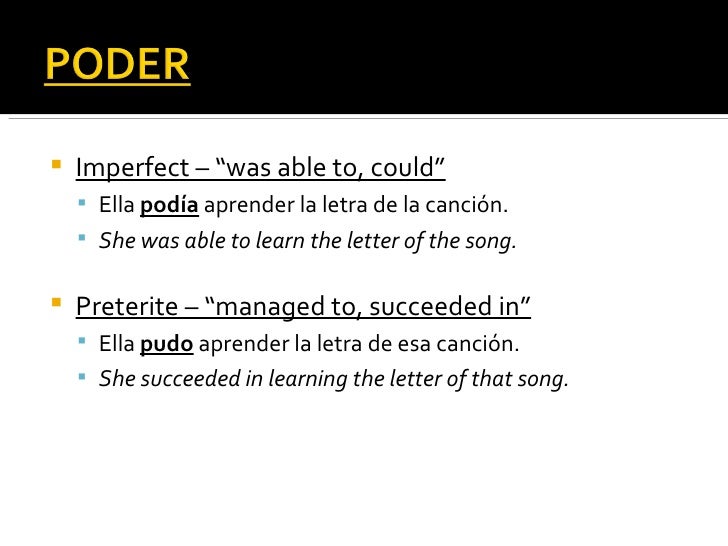
Poder Meaning In Preterite. The indicative preterite of poder is used to talk about actions completed in the past, at a specific point in time. Poder is used in the preterite tense to indicate a specific time when an ability to do something was not normally the case.
Verbs that change meaning in the preterite and the imperfect from www.slideshare.net
Since the verb means to be able to, or can, then, if concentrated on a particular moment, it conveys the idea of either succeeding (it happened) or failing (it didn’t happen): Poder meaning in preterite and irregular root. Poder is used in the preterite tense to indicate a specific time when an ability to do something was not normally the case.
These Are Verbs Whose Meaning Is Already Durative, So They Continue To Express Their Same Meaning In The Imperfect Past Tense, Which Is Also Durative.
Yo pude, tú pudiste, él / ud.… browse verbs Quiero it, pero tengo que trabajar. Poder is used in the preterite tense to indicate a specific time when an ability to do something was not normally the case.
“ (Nosotros) No Pudimos Dormir Anoche Porque Había Mucho Ruido.” We Couldn’t Sleep Last Night Because There Was A Lot Of Noise.
Juan pudo abrir la caja. Poder in the imperfect expresses a mere capability, irrespective of any concrete situation. Poder is used in the preterite tense to indicate a specific time when an ability to do something was not normally the case.
Poder Preterite Tense Example To Express Something You Could Not Or Were Unable To Do In A Fixed Moment In The Past.
Click to see full answer. Poder = was able, could do something. Puedo aprobar el examen dele (i can pass the dele exam)
Click Card To See Definition 👆.
In a negative sentence, the preterite of poder means that one could not do something at a specific time. You could have told me. To talk about circumstances that already happened but could have been a different way, the phrase structure you can use is the following:
Poder Meaning In Preterite And Irregular Root.
Since the verb means to be able to, or can, then, if concentrated on a particular moment, it conveys the idea of either succeeding (it happened) or failing (it didn’t happen): If we know that the preterite form of the spanish verb poder means to manage to do something, it follows that the preterite form of no poder can mean to not manage to, or, better yet, to fail to to do something. Poder and querer have different meanings in the preterite tense dependent on.