Chemotaxis In Bacteria Occurs Through The Use Of. They alter course by abruptly changing the direction of this rotation. Motile escherichia coli placed at one end of a capillary tube containing an energy source and oxygen migrate out into the tube in one or two bands, which are clearly visible to the naked eye and can also be demonstrated by photography, microscopy, and densitometry and by assaying for bacteria throug.
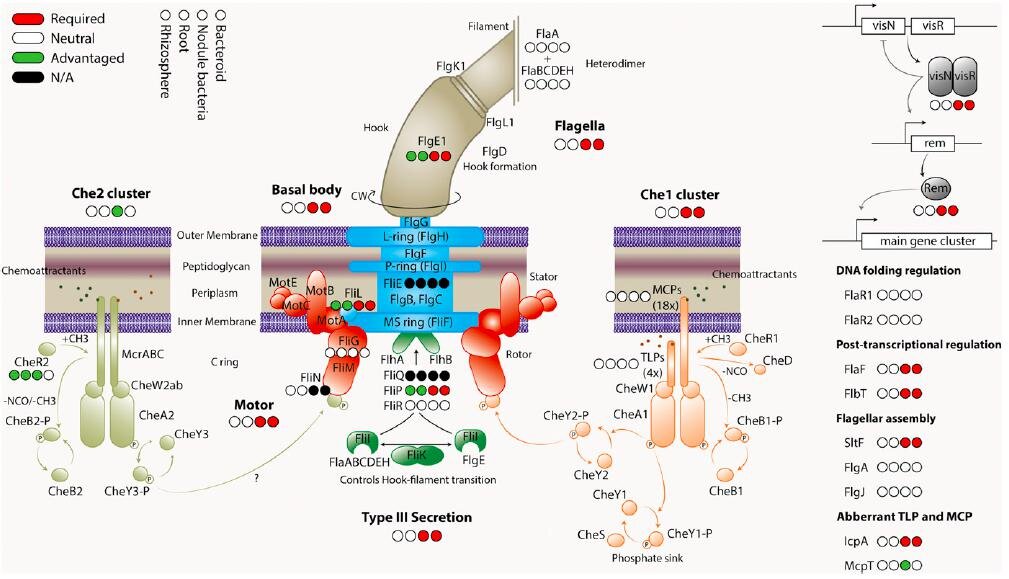
Rhizobium adapts lifestyles from rhizosphere to symbiosis from phys.org
Role of chemotaxis in the transport of bacteria through saturated porous media roseanne m. Received in revised form 16. Chemotaxis in bacteria bacteria swim by rotating their flagella.
The Bias Depends On The Way In Which The Concentration Of The Attractant Or Repellent Changes With Time.
The link between bacterial navigation and nutrient cycling highlights the need to understand how chemotaxis functions in the context of marine microenvironments. Chemotaxis is the process by which the bacteria respond to chemical gradients. Chemotaxis, however, is not limited to eukaryotic cells but is also employed by bacterial (prokaryotic) cells.
Chemotaxis In Bacteria Is Due To.
Chemotaxis in bacteria bacteria swim by rotating their flagella. Chemotaxis is movement of bacteria towards or against some chemicals positive chemotaxis occurs if the movement is toward a higher concentration of the chemical in question and negative chemotaxis if the movement is in the opposite direction. Bacterial chemotaxis proteins enable bacteria to sense temporal gradients of various molecules and use this information to direct their swimming toward more favorable environments, for example, toward nutrients such as amino acids and sugars.
Although Individual Escherichia Coli Bacteria Sense Temporal Changes In The Number Of Occupied Receptors [41] , They Also Respond To Spatial Gradients Because They Actively Swim Through Them, Thus Exposing The Receptors To A Temporal.
Chemotaxis in bacteria ecology and physics of bacterial chemotaxis in the ocean. In escherichia coli the motile behavior is reduced to a binary response: Received in revised form 16.
In Unicellular Organisms, Such As Bacteria And Amoebae, Chemotaxis Is Frequently Used As A Foraging Mechanism [1].
Chemotaxis is the directed migration of cells in response to concentration gradients of extracellular signals. Chemically prompted kinesis (randomly directed or nondirectional) is called chemotaxis or chemokinesis. Chemotaxis in bacteria occurs through the use of.
This Is The Case Especially For The Flagellar Enteric Bacteria Such As Escherichia And Salmonella.
Harvey b a department of chemical engineering, university of virginia, charlottesville, va 22904, united states b water resources division, united states geological survey, boulder, co 80303, united states received 8 january 2006; It is a phenomenon in which bacteria & other microbes moves towards or away from some chemicals present in the environment this is very essential for microbes to search the food around them there are two types of chemotaxis, 1. Chemotaxis, the ability of motile bacteria to direct their movement in gradients of attractants and repellents, plays an important role during the rhizosphere colonization by rhizobacteria.